
ORNITHOGALUM CHRISTINIAE
Family and Genus:- See-
Common Name:- None
Homotypic Synonyms:- None
Meaning:- Ornithogalum (Gr) Bird-milk, a name used by the Greek physician and
botanist Dioscorides for plants yielding bird-lime.
Christiniae (L) Dedicated to Dr Christini Fournaraki, Mediterranean
Agronomical Institute of Chania
General description:-
Bulb:-
1) Spherical, to sub-spherical 2.0-2.7 cm in diam.
Scape:-
1) Glabrous, 2-5 cm long; flowering plants 8-14(17) cm tall.
Leaves:-
1) 6-10, proteranthus, glabrous, diverging almost horizontally or arching (rarely),
persistent at anthesis, linear-tapering, broadest below the middle, 8-25(45) cm
long and 0.6-1.1(1.5) cm wide, concolorous shiny green or rarely with a very
narrow white line about 1 mm wide, thin-papyraceus, flexible, flat or slightly
canaliculate, with corrugated and somewhat wavy surfaces and very narrow,
smooth, translucent margins.
Flowers:-
1) Inflorescence, a lax, 6-12(18) cm long, corymbiform to subcylindrical raceme with
5-12(15) flowers.
2) Pedicels, straight, 2-7 cm long, at first erecto-patent, becoming reflexed after
anthesis, diverging up to an angle of about 120°-130°, at the fruiting stage
elongating to about 20%, gradually thickening towards base and rachis of
infructescence becoming flexuose.
3) Bracts. membranous, whitish, lanceolate-acuminate 1.5-3.5 × 0.4-1.0 cm, 5-8-
nerved and 0.3-0.5 times as long as the floral pedicels.
4) Tepals, white with a green stripe beneath, oblanceolate to narrowly elliptic,
subacute at the apex, 5-nerved, patent, slightly canaliculate, 13.0-19.0(21.0) mm
long × 3.6-5.6(6.0) mm wide, the outer three cucullate at apex, ending in a small
sub-globose appendix, consisting of 50-80 small papillae; green stripe broad,
occupying 4/5 of the outer tepal's width, while it occupies only the 1/4 of the
three, inner tepals.
5) Ovary, sub-cylindrical, depressed at apex, green with yellowish top, 4.0-5.0 × 2.0
- 3.5 mm.
a) lobes, contiguous in 3-pairs with 7-12 ovules per carpel.
6) Style, white, 2.0-2.5(3.0)mm long, about 0.4-0.5 times as long as the ovary;
a) stigma, truncate, papillose.
7) Filaments, 6.5-8.5 × 1.5-2.5 mm, entire, oblong with parallel sides, abruptly
contracted to a short filiform apex, on inner surface with three thickened and
prominent nerves.
8) Anthers, dorsifixed, dirty white, oblong 2.5-3.0 × 1.0-1.3 mm.
Fruit:-
1) Capsules, oblong to ovoid 10-15(17) × 6-9 mm, emarginate at apex with apical
lobes contiguous in three pairs and conspicuously winged (1-2 mm wide), when
dry becoming coriaceous, yellowish-brown, venulose, minutely wrinkled and
opening like a star.
2) Seeds, ovate to sub-globose, slightly apiculate 2.0-2.3 mm in diam.
a) testa black, prominently reticulate. Germination hypogeal.
Key features:-
1) Leaf, surface wrinkled and corrugated.
2) Pedicels of the lower fruits thickened at the base and reflected.
3) Capsules. winged with apical lobes, contiguous in three pairs.
Habitat:- Grows on rocky, calcareous substrate among phrygana and several
therophytes such as Thymbra capitata
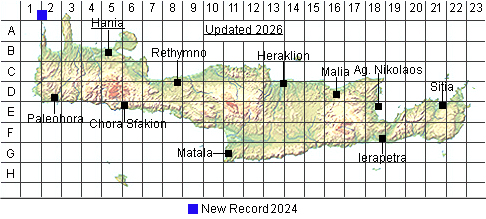
Distribution:- A new species of Ornithogalum discovered on Agria Gramvousa by
Dr Christini Fournaraki, Mediterranean Agronomical Institute of Chania, et,al.
Mar. 2021
Flowering time:- End of February to the end of March
Photos by:-
SPECIES DESCRIPTION